


A good neoprene wetsuit is an investment. Whether it’s a 3/2 mm for summer sessions or a 5/4 mm for winter waves, its lifespan depends as much on its build quality as on how well you care for it after every session.
Still, many surfers make the same mistakes: leaving their wetsuit to dry in direct sunlight, rinsing it quickly in hot water, storing it folded in a car trunk, or using regular laundry detergent. These bad habits don’t damage neoprene right away, but they accelerate aging, reduce flexibility, and eventually compromise thermal insulation.
On the other hand, a few simple steps are all it takes to keep your wetsuit performing well for several seasons. This guide brings together the best practices used by riders and surf schools to preserve neoprene’s elasticity, prevent bad odors, and avoid premature wear.

Neoprene is a technical material. Contrary to what you might think, it’s not simply waterproof foam. It’s made up of millions of gas-filled microcells that trap body heat while remaining flexible enough to move with you.
This material is particularly sensitive to several external factors.
Salt, sand, and UV rays: neoprene’s main enemies
After a session, the wetsuit always retains some seawater. As it evaporates, it leaves salt crystals that settle into the fabric fibers, seams, and zippers. Over time, these deposits stiffen the fabric and accelerate wear in high-stress areas like the shoulders, knees, and elbows.
Sand acts as an abrasive. Trapped in the seams or under the zipper, it causes tiny friction with every movement. A zipper that’s hard to pull isn’t necessarily worn out: it’s often just clogged with sand.
UV rays are another often underestimated factor in aging. Repeated exposure to the sun gradually degrades the polymers in neoprene. The foam then loses its elasticity, the panels become stiffer, and the colors fade.
How neoprene really ages
Contrary to popular belief, a wetsuit doesn’t only get damaged when you’re wearing it.
Wetsuits also age due to:
- repeated drying cycles;
- temperature fluctuations;
- stagnant moisture;
- mechanical strain when the wetsuit is hung on an unsuitable hanger;
- organic residue (sweat, bacteria, urine, sunscreen).
These elements eventually damage both the foam and the outer fabrics.
A well-maintained wetsuit can easily keep performing well for four to six seasons of regular use, sometimes longer with occasional use.
MDNS tip
A wetsuit rinsed for two minutes after every session will often last longer than one that's thoroughly washed once a month but left full of salt between sessions. Regular care matters more than the occasional deep clean.

What to do after every session
Laily care takes less than five minutes. Yet it's what makes all the difference in the long run.
Rinse immediately with fresh water
The first step is to remove salt, sand, and organic residue as soon as you get back from your session.
Leally, use fresh, cool or slightly warm water.
Water that's too hot speeds up the aging of the adhesives used on some watertight seams (GBS) and can gradually reduce the material's elasticity.
Rinse both the inside and outside of the wetsuit.
Pay particular attention to:
- at the wrists;
- at the ankles;
- at the collar;
- at the back zip or front zip;
- at the seams.
These areas collect more sand and salt.
Turn the wetsuit inside out for the first part of drying
Lining the inside is usually the dampest after a session.
To speed up drying without unnecessarily exposing the outer lining, it's recommended to turn the wetsuit completely inside out.
Once the inner lining is dry, simply turn the wetsuit right side out again to finish drying the outside.
This method also helps preserve the water-repellent treatments found on some high-end models for longer.
Choose the right hanger
Not all hangers are created equal.
Very thin metal hangers concentrate the wetsuit's weight on just a few millimeters.
The result:
- misshapen shoulders;
- permanent creases;
- premature wear of the neoprene.
A wide hanger designed specifically for wetsuits spreads the weight over a larger surface area and reduces mechanical stress.
When the wetsuit is still very heavy because it's saturated with water, it's best to dry it folded on a flat surface before hanging it up to finish drying.
Keep it out of direct sunlight
Drying your wetsuit in the sun seems logical.
Yet this is one of the most common mistakes.
UV rays speed up neoprene oxidation and gradually weaken the outer fabrics.
L'ideally, choose a place that is:
- well-ventilated;
- shaded;
- at a moderate temperature.
A ventilated garage, covered patio, or well-ventilated laundry room are all ideal.
L's take
After a winter surf session, it's tempting to dry your wetsuit near a radiator or stove. Direct heat dries out the foam and gradually reduces its flexibility. Slower drying does a much better job of preserving its thermal performance.
![]() How to deep-clean a neoprene wetsuit
Daily rinsing is no substitute for proper cleaning.
Over the weeks, sweat, bacteria, sunscreen residue, and microorganisms build up in the fabric fibers.
This buildup causes persistent odors and encourages mold to grow.
How often should you give it a thorough clean?
It all depends on how you use it.
| Surfing frequency | Recommended cleaning |
|---|---|
| Occasional vacations | At the end of your trip |
| 1 session per week | Every 4 to 6 weeks |
| 2 to 3 sessions per week | Every 3 weeks |
| Heavy use | Every 2 weeks |
If you use your wetsuit regularly in warm water or wear it for long periods, more frequent cleaning is best.
Which product should you use?
A cleaner specifically made for neoprene is still the best solution.
These products are formulated to:
- eliminate bacteria;
- neutralize odors;
- protect the seams;
- protect technical fabrics.
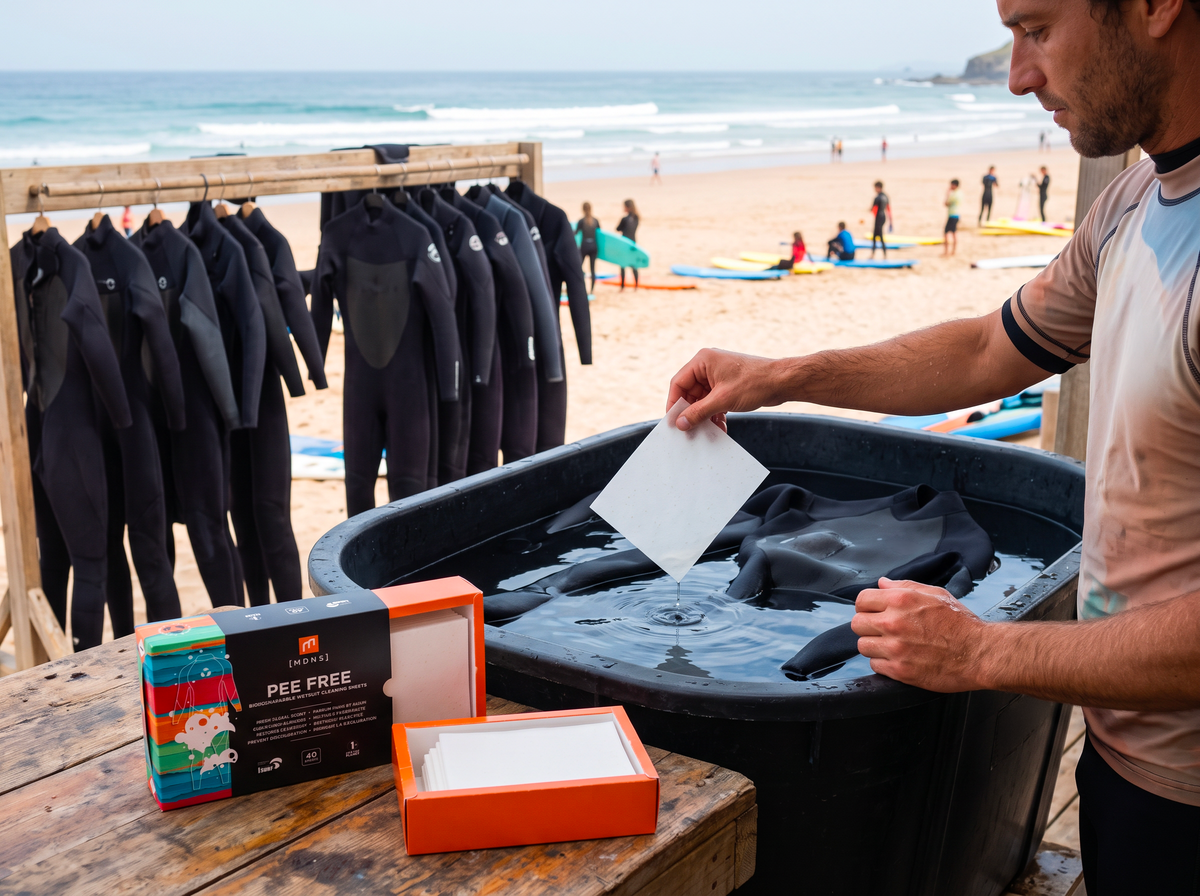
Among the practical solutions, PEE FREE Neoprene Wash Sheets, available in the Surf Neoprene Accessories category, offer effective cleaning without using liquid detergent. They dissolve easily in water and let you clean your wetsuit while reducing plastic packaging.
L's easy to use:
- fill a basin with lukewarm water;
- add the cleaning sheet;
- leave to soak for about 15 minutes;
- rinse thoroughly with clean water;
- leave to dry in the shade.
This method effectively eliminates odors while preserving the flexibility of the neoprene.

Products to avoid at all costs
Some "homemade" solutions regularly circulate on the internet.
They’re still not recommended.
Avoid:
- bleach;
- standard detergents;
- powder detergent;
- fabric softener;
- solvents;
- household cleaners;
- turpentine.
Even if the effects aren’t always immediately visible, these products gradually weaken the glue and accelerate the material’s aging.
White vinegar is sometimes touted as a miracle solution for odors. Used occasionally and highly diluted, it can help neutralize some bacteria. However, repeated use isn’t recommended on more technical wetsuits, particularly those with glued seams or thermal linings.
MDNS tip
If your wetsuit has a slight odor despite regular rinsing, there’s no need to use more product. Soaking it longer in a specialist cleaner is often far more effective than an aggressive wash.
- Check out our selection of Surf Neoprene Accessories to care for your gear in the best possible conditions.
- If your wetsuit shows signs of advanced wear, it may be time to compare the models in our Men’s Surf Wetsuits or Women’s Surf Wetsuits collection, depending on how you surf.
Can you machine-wash a neoprene wetsuit?
The answer is simple: in most cases, no.
Even if some manufacturers say a cold, delicate cycle is an option, machine-washing is still an unnecessary risk. The drum’s movement, even at low speeds, puts a lot of stress on the seams, glued panels, and most flexible areas of the neoprene.
With a newer wetsuit, damage isn’t always immediately visible. However, the glue gradually loses its effectiveness and the fabrics can stretch out more quickly.
If you really have no other option, take a few precautions:
- wool or delicate cycle;
- cold water (20 to 30°C maximum);
- no spin cycle;
- no fabric softener;
- no standard detergent.
In any case, hand-washing is by far the better option. It’s quicker than you might think and much gentler on the materials.
MDNS tip
A high-end wetsuit can cost several hundred euros. A few minutes of hand-washing after several weeks of use can often prevent premature wear and keep it flexible for much longer.
How do you get rid of bad odors for good?
Every wetsuit eventually starts to smell... even when it looks clean.
This smell doesn't come only from seawater. It's mainly caused by bacteria that feed on sweat, dead skin cells, and organic residue trapped in the fabric fibers.
So a quick rinse with fresh water isn't always enough.
Good habits
To keep odors from setting in:
- rinse it immediately after every session;
- never leave the wetsuit damp in a sealed bag;
- let the inside dry completely before putting it away;
- give it a thorough clean every few weeks.
A specialist clean with PEE FREE Wash Sheets, available in our selection of Surf Neoprene Accessories, helps neutralize the bacteria responsible for bad odors without damaging the neoprene.

Mistakes that make the problem worse
Some habits, on the other hand, encourage bacterial growth:
- leave the wetsuit in the car trunk for several days;
- fold it while it's still wet;
- store it in a sealed dry bag;
- never clean the inside.
LMoisture combined with heat creates an ideal environment for microorganisms.
How to dry your wetsuit properly: the method used by surf schools
Drying is probably the most overlooked step... even though it directly affects the wetsuit's lifespan.
Step 1: Dry the inside
After rinsing, turn the wetsuit completely inside out.
Hang it on a wide hanger or drape it over a bar thick enough not to leave marks on the shoulders.
L's goal is to let the inner lining release all its moisture.
Step 2: Turn the wetsuit right-side out
Once the inside is dry, turn the wetsuit right-side out so the outer fabric can finish drying.
This method prevents moisture from getting trapped in the panels.
Step 3: Wait
A thick winter wetsuit (5/4 mm or 6/5 mm) can take more than 24 hours to dry completely, depending on the outdoor temperature.
Trying to speed up the process with a hair dryer, radiator, or stove is counterproductive.
Excessive heat gradually dries out the foam and reduces its ability to retain warmth.
The role of ventilation
Good airflow is often more effective than high temperatures.
A shaded, well-ventilated, dry place is still the best option.
L's take
Modern thermal linings dry much faster than older generations of neoprene. However, they're still sensitive to direct heat. Even if the inside feels dry, always leave it for a few extra hours before putting your wetsuit away.
How should you store a wetsuit for several weeks or an entire winter?
Storage is often responsible for permanent creases and loss of flexibility.
A wetsuit can go unused for several months. If stored properly, it'll be ready to perform at its best again next season.
Always completely dry
Before storing it for a long time, the wetsuit must be completely dry.
Even a little moisture can encourage:
- mold;
- lingering odors;
- fabric deterioration.
Hung or folded?
For storage lasting a few weeks, a wide hanger is still the best option.
For several months, either of these options works:
- hung on a dedicated neoprene hanger;
- loosely rolled without creating a sharp crease.
However, avoid folding it into quarters in a box or underneath other gear.
Creases eventually weaken the foam.
The right place
Avoid:
- an attic in the middle of summer;
- a damp garage;
- a car trunk;
- a poorly ventilated basement.
The best environment is:
- dry;
- moderate;
- out of the sun.
Mistakes that destroy a wetsuit faster than you'd think
Some practices are common among beginner surfers… but also among more experienced ones.
| Bad habit | Consequence |
|---|---|
| Drying in direct sunlight | Loss of elasticity, discoloration |
| Very hot water | Adhesive aging |
| Thin metal hanger | Shoulder deformation |
| Damp, closed bag | Mold and odors |
| Washing machine spin cycle | Seam wear |
| Regular laundry detergent | Neoprene deterioration |
| Radiator or tumble dryer | Neoprene foam drying out |
| Prolonged folding | Permanent creases appear |
Most of these mistakes don't damage the wetsuit right away. Their effects are gradual, which is why many surfers only make the connection after several seasons.
Repair or replace?
A small tear doesn't necessarily mean you need to replace your wetsuit.
A repair is enough when:
- the cut is just a few centimeters long;
- a seam is starting to come apart;
- a knee pad is coming slightly loose;
- a panel has a small cut.
Neoprene-specific glue can often extend the life of your wetsuit by several years.
It's best to replace your wetsuit when:
- several seams are leaking;
- the neoprene has become stiff;
- the panels are cracking;
- the thermal insulation is no longer sufficient;
- repairs are becoming frequent.
In this case, it may be worth comparing the latest generations of Men's Surf Wetsuits, Women's Surf Wetsuits or Winter Surf Wetsuits, whose materials now offer a much better balance between warmth, flexibility and durability.
MDNS tip
A small repair made as soon as a tear appears often costs just a few dollars. Waiting several months can turn a simple cut into a gap that's difficult to repair.
Accessories that really make wetsuit care easier
Not every accessory is essential. Still, some can save you time and extend the life of your gear.
| Accessory | Use | Essential? |
|---|---|---|
| Wide hanger for wetsuits | Prevents deformation | ⭐⭐⭐⭐⭐ |
| PEE FREE wash sheets | Cleaning and odor neutralizing | ⭐⭐⭐⭐⭐ |
| Breathable transport bag | Transport after your session | ⭐⭐⭐⭐☆ |
| Neoprene glue | Repair a tear quickly | ⭐⭐⭐⭐☆ |
| Soft brush | Clean the zippers | ⭐⭐⭐☆☆ |
Find these products in our selection of Surf Neoprene Accessories, designed for everyone from occasional surfers to those who hit the waves regularly.
Wetsuit care also helps preserve its performance
A well-maintained wetsuit doesn't just last longer. It stays more comfortable, too.
Flexible neoprene makes paddling easier, reduces shoulder fatigue and retains its thermal properties better. By contrast, material stiffened by salt, UV rays or improper drying gradually becomes less comfortable during sessions.
Just a few minutes of care after each surf is enough to preserve these qualities for several seasons.

FAQ: Everything you need to know about wetsuit care
Should you rinse your wetsuit after every session?
Yes, it's the most important step. Rinsing with fresh water removes salt, sand, sunscreen residue, and some of the bacteria before they become embedded in the neoprene. Even a 30-minute session deserves a thorough rinse.
Can you machine-wash a neoprene wetsuit?
This is not recommended. Washing machine cycles put a lot of strain on glued seams and neoprene panels. Even on a delicate cycle, the drum's movement can accelerate wear. Hand washing with a dedicated cleaner remains the safest option.
What product should I use to clean a surf wetsuit?
Choose a cleaner specially designed for neoprene. These products eliminate odor-causing bacteria while protecting the glue, seams, and material's elasticity. PEE FREE Neoprene Wash Sheets, available in the Surf Neoprene Accessories category, offer a practical, effective, and more environmentally friendly solution.
Can you use white vinegar?
White vinegar can occasionally help neutralize certain odors when heavily diluted. However, repeated use is not recommended on modern wetsuits, particularly those with thermal linings or sealed seams. A dedicated product remains safer and more effective over the long term.
Why does my wetsuit smell bad even after rinsing?
Rinsing removes salt and impurities, but it doesn't kill all the bacteria that cause odors. Over time, perspiration, dead skin cells, and moisture encourage them to grow. A thorough clean every few weeks helps keep your wetsuit fresh for longer.
How long does it take a wetsuit to dry?
It depends on its thickness, the temperature, and ventilation. A summer 3/2 mm wetsuit can dry in a day under good conditions. A winter 5/4 mm or 6/5 mm wetsuit will often take more than 24 hours. Leaving it to dry inside first, then outside, in a shaded, well-ventilated place is ideal.
How should you store a wetsuit over the winter?
Before extended storage, make sure it is completely dry. Hang it on a wide hanger or roll it without creating a sharp crease. Avoid damp places, overheated attics, or your car trunk. A dry, temperate place away from UV rays is ideal.
How long does a neoprene wetsuit last?
Lifespan depends mainly on how often you use and care for your wetsuit. A good-quality wetsuit that's used regularly and properly maintained can perform excellently for 4 to 6 years, or even longer with occasional use.
How do you repair a small tear?
A cut a few centimeters long can usually be repaired with specialist neoprene glue. It's best to fix it quickly before the tear gets bigger. However, if several panels are damaged or the seams are coming apart over a long section, replacing the wetsuit is often the better option.
Key points to remember
Looking after a neoprene wetsuit takes little time and equipment. The right habits after every session make all the difference:
- always rinse with fresh water;
- dry in the shade in a well-ventilated place;
- avoid direct sources of heat;
- clean regularly with a suitable product;
- store the wetsuit completely dry on a wide hanger or rolled up without creases.
These simple steps help preserve the neoprene's flexibility, keep bad odors at bay and extend your gear's thermal performance.
Whether you surf for a few weeks a year or all year round, regular care is the best way to get more life out of your wetsuit and put off replacing it.
MDNS
- Looking for a wetsuit suited to cold water? Check out our selection of Winter Surf Wetsuits.
- Need a new wetsuit for your regular sessions? Browse our range of Men's Surf Wetsuits.
- Also check out our collection of Women's Surf Wetsuits, designed to deliver warmth, freedom of movement and durability.
- To kit out the groms, browse our Kids' Surf Wetsuits.
- Finally, all the products you need for cleaning, storage and repairs are grouped together in our Surf Wetsuit Accessories category.


Leave a comment
This site is protected by hCaptcha and the hCaptcha Privacy Policy and Terms of Service apply.